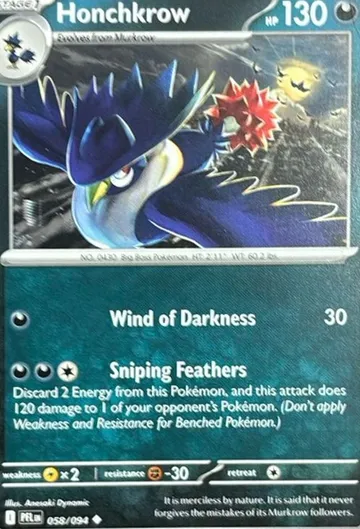
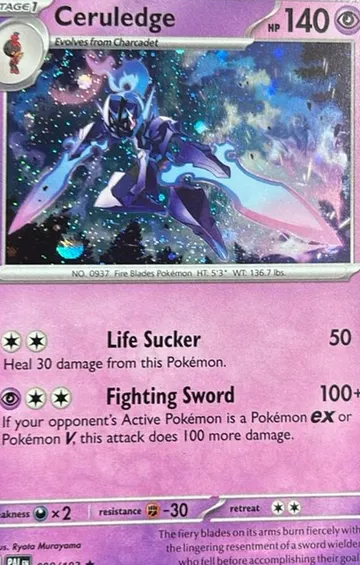
The 10-second tilt test
- Hold the card under a single bright light, like a desk lamp or a window. Overhead room light works less well.
- Tilt it slowly toward you and away, then side to side.
- Watch which parts flash and change colour, and which stay flat.
| What you see when you tilt | Finish |
|---|---|
| Nothing changes; the whole card stays matte | Plain (non-holo) |
| The picture flashes; the text box and borders stay flat | Holo |
| The text box and the area around the picture flash; the picture stays flat | Reverse holo |
| The whole card, including the picture, is textured or shiny edge to edge | A special rare (full art, illustration rare and similar), not a reverse holo |
The tilt test is the one that settles it. Photos flatten shine, so a card that looks plain in a picture can still be a reverse holo in your hand.
The shortcut on modern cards: look behind the attack text
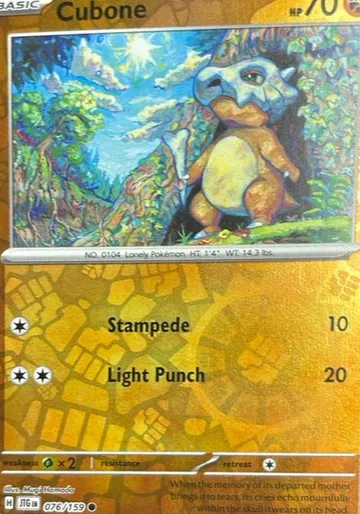
On most Scarlet & Violet era cards (2023 onward), reverse holos carry a large pattern behind the attack text: a big circle or gear with the Pokémon's energy symbol in it, or a Poké Ball on Trainer cards, surrounded by repeating shapes. A plain card has only a soft, mottled texture there.
Because that pattern is printed in the foil, it usually shows even in a flat photo where you can't see any shine. When we checked a batch of real cards, every one with that pattern turned out to be reverse holo when tilted.
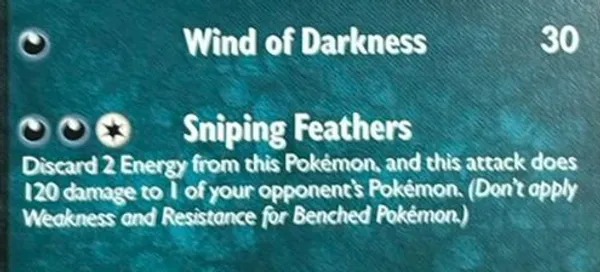
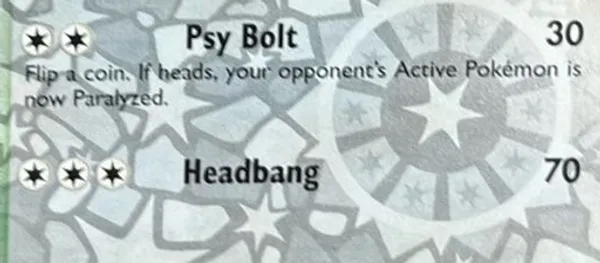
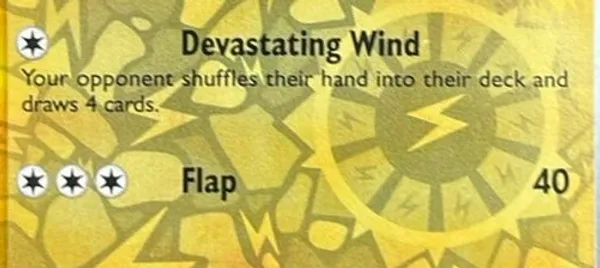
Where the shortcut fails: some special sets use a different reverse pattern, like a brushed sweep or a Poké Ball design, instead of the energy circle. And a plain card photographed under glare can look like it has a pattern. If it matters for value, do the tilt test.
Why the number doesn't tell you
Plain, holo and reverse holo versions of a card share the same set and card number, like 098/193. So two cards with identical numbers can differ in price, and a price lookup by number alone may mix them up.
Not every card exists in every finish. Commons and uncommons usually come plain or reverse holo. Many rares come holo or reverse holo. The top rarities (ex cards, full arts, illustration rares) usually have just one version. If you're unsure whether a finish exists for your card, look it up by set and number in a card database and check which versions it lists.
Where to find the set and number
On modern cards, look at the bottom-left corner. You'll find a small regulation letter, a three-letter set code (for example PAL for Paldea Evolved) and the card number with the set size, like 098/193. Older cards place these differently, often at the bottom right, and show the set as a small symbol rather than a code.
The rarity symbol sits next to the number: a circle for common, a diamond for uncommon, a star for rare. Any of these can come as a reverse holo.
Are reverse holos worth more?
Usually a bit more than the plain version of the same card, because fewer are printed. For most commons and uncommons the gap is small. For popular Pokémon, or older sets, it can be more. Either way, check the finish before you look up a price, so you're comparing the right version.
How Card Detective handles it
When you scan a Pokémon card, Card Detective reads the name and card number from your photo, looks the card up in a card database, and checks the finish against the versions that card was actually printed in. It also looks for the reverse-holo pattern behind the text. It can still be fooled by glare, so if the finish it shows doesn't match what you see when you tilt the card, trust the tilt.